SaaS AI Visibility Index · Answer Engine Optimization Software · Mixed company sizes · November 2026
We asked ChatGPT and Google’s AI Overviews the twenty questions that small, mid-sized and enterprise buyers ask when they choose an answer engine optimization (AEO) tool, thirty times each. Profound, Peec AI and Otterly.AI lead, and only 2 of G2’s 7 AEO Leaders are named in a quarter of AI answers.
The AI Visibility Grid: answer engine optimization software, mixed company sizes
Up: how often AI names the tool. Right: how early it names it, against what chance would give. Each dot is coloured by the tool’s G2 position.
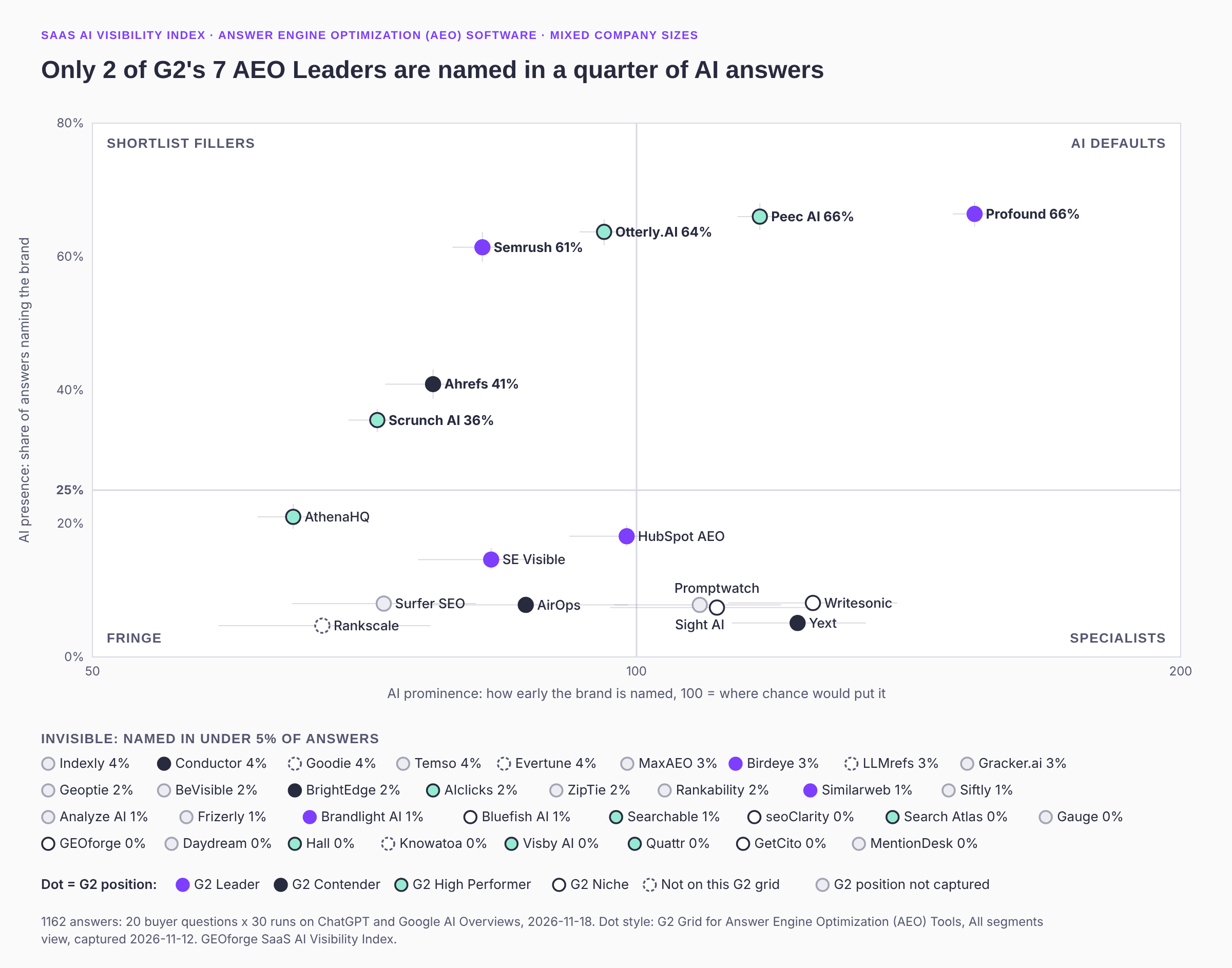
Tap or click the grid to open it full size. Lines through each dot show its likely range. A dot whose lines cross the middle lines could sit in the next box, so read box positions as a guide, not a ranking.
Buyers now ask an AI assistant which tool will get them into AI answers, which makes this category a test of its own pitch. So we compared two leaderboards: who G2’s reviewers rank as leaders, and who ChatGPT and Google’s AI actually recommend. GEOforge is one of the vendors measured here. We measured ourselves with the same method, and neither engine named GEOforge in any of the 1,162 answers.
ChatGPT leans harder on the specialists than Google does
Share of answers that name each tool, by engine. Hover a bar for the exact figure.
Top 12 tools by share of all answers. Bars are scaled to 90%.
Profound, mostly. In 19 of the 20 questions one tracked tool is the one AI names first most often, and 8 different tools share those wins. Profound takes 8, including the general and enterprise questions. Peec AI wins mid-sized companies, agencies, ecommerce and the head-to-head comparison. Otterly.AI wins small businesses and the easiest tool to set up, two questions where Profound is named in only 23% and 10% of answers. Semrush wins monitoring Google’s AI Overviews, HubSpot’s AEO tools free or low-cost tracking, Writesonic tools that also create content, Promptwatch tracking in several countries and languages, and Yext local businesses with several locations. The crawler question has no winner: all 59 answers point to robots.txt and Cloudflare’s crawler settings, and only 2 of them name a tracked tool at all.
| Question | Profound | Peec AI | Otterly.AI | Semrush | Ahrefs | Scrunch AI | Named first most often |
|---|---|---|---|---|---|---|---|
| Best AEO software | 85% | 81% | 92% | 95% | 53% | 63% | Profound (64%) |
| Track my brand in AI | 100% | 100% | 100% | 82% | 92% | 68% | Profound (65%) |
| Small business | 23% | 79% | 89% | 66% | 6% | 32% | Otterly.AI (74%) |
| Mid-sized B2B | 97% | 66% | 24% | 68% | 34% | 49% | Peec AI (42%) |
| Google AI Overviews | 77% | 65% | 83% | 95% | 70% | 3% | Semrush (63%) |
| Free or low-cost | 5% | 58% | 84% | 28% | 42% | 2% | HubSpot AEO (37%) |
| Agencies | 83% | 78% | 57% | 74% | 43% | 57% | Peec AI (65%) |
| Get cited by AI | 88% | 72% | 86% | 74% | 67% | 47% | Profound (69%) |
| Enterprise share of voice | 95% | 76% | 31% | 71% | 44% | 66% | Profound (80%) |
| Also creates content | 50% | 18% | 27% | 68% | 15% | 17% | Writesonic (53%) |
| Instead of SEO tools | 88% | 90% | 77% | 85% | 73% | 47% | Profound (62%) |
| Brand vs competitors | 97% | 93% | 97% | 84% | 84% | 53% | Profound (64%) |
| Ecommerce | 72% | 70% | 50% | 27% | 22% | 25% | Peec AI (50%) |
| Compare, mid-sized | 87% | 95% | 97% | 68% | 52% | 53% | Peec AI (48%) |
| Easiest to set up | 10% | 58% | 80% | 36% | 8% | 3% | Otterly.AI (66%) |
| AI traffic to my site | 70% | 48% | 32% | 43% | 35% | 8% | Profound (32%) |
| Fix wrong AI information | 68% | 65% | 72% | 42% | 40% | 53% | Profound (51%) |
| Countries & languages | 96% | 83% | 70% | 76% | 22% | 57% | Promptwatch (37%) |
| Can AI crawlers read my site | 0% | 0% | 0% | 2% | 2% | 0% | No AEO tool |
| Local, several locations | 32% | 25% | 30% | 45% | 7% | 7% | Yext (61%) |
Two of them clearly do. G2’s Answer Engine Optimization grid lists 7 of the tools we tracked as Leaders. Profound (66%) and Semrush (61%) are among AI’s top four, and HubSpot AEO (18%) and SE Visible (15%) appear in more than one answer in ten. The other three, Birdeye (3%), Similarweb (1%) and Brandlight AI (0.9%), appear in fewer than one in twenty, though Similarweb and Birdeye have more than a thousand G2 reviews each. And three G2 High Performers, Hall, Visby AI and Quattr, never appeared at all.
| Tool | G2 quadrant (all segments) | Named in AI answers | Likely range * | Average position | Named first |
|---|---|---|---|---|---|
| Profound | Leader | 66% | 64–68% | 2.2 | 47% |
| Peec AI | High Performer | 66% | 64–68% | 2.6 | 20% |
| Otterly.AI | High Performer | 64% | 62–66% | 3.3 | 17% |
| Semrush | Leader | 61% | 59–64% | 4.0 | 13% |
| Ahrefs | Contender | 41% | 39–43% | 4.3 | 9% |
| Scrunch AI | High Performer | 36% | 34–37% | 4.1 | 2% |
| AthenaHQ | High Performer | 21% | 19–23% | 4.7 | 0.4% |
| HubSpot AEO | Leader | 18% | 17–20% | 3.5 | 29% |
| SE Visible | Leader | 15% | 13–16% | 4.2 | 13% |
| Writesonic | Niche | 8% | 7–9% | 3.2 | 35% |
| AirOps | Contender | 8% | 7–9% | 4.2 | 11% |
| Promptwatch | Niche | 7% | 6–9% | 3.3 | 24% |
| Yext | Contender | 5% | 4–6% | 2.1 | 63% |
| Rankscale | Not on the AEO grid | 5% | 4–6% | 4.4 | 4% |
| Conductor | Contender | 4% | 3–5% | — | — |
| Goodie | Not on the AEO grid | 4% | 3–5% | — | — |
| Evertune | Not on the AEO grid | 4% | 3–5% | — | — |
| Birdeye | Leader | 3% | 3–4% | — | — |
| LLMrefs | Not on the AEO grid | 3% | 2–4% | — | — |
| BrightEdge | Contender | 2% | 1–3% | — | — |
| AIclicks | High Performer | 2% | 1–3% | — | — |
| Similarweb | Leader | 1% | 0.9–2% | — | — |
| Brandlight AI | Leader | 0.9% | 0.5–2% | — | — |
| Bluefish AI | Niche | 0.8% | 0.4–1% | — | — |
| Searchable | High Performer | 0.6% | 0.3–1% | — | — |
| seoClarity | Niche | 0.4% | 0.2–0.9% | — | — |
| Search Atlas | High Performer | 0.4% | 0.2–1% | — | — |
| GEOforge | Niche | 0% | 0–0.3% | — | — |
| Hall | High Performer | 0% | 0–0.3% | — | — |
| Knowatoa | Not on the AEO grid | 0% | 0–0.3% | — | — |
| Visby AI | High Performer | 0% | 0–0.3% | — | — |
| Quattr | High Performer | 0% | 0–0.3% | — | — |
| GetCito | Niche | 0% | 0–0.3% | — | — |
* Likely range: AI gives a different answer each time, so we asked every question thirty times. If we asked these same questions again, the share would land inside this range 95 times in 100. It describes these questions only: a different set of questions could give different shares. When two tools’ ranges overlap, treat them as a tie. Average position is where the tool appears among the tools an answer names (1 = first); named first is the share of its own mentions in which it comes first. Both are shown only for tools named in at least 5% of answers and 20 times in all.
Mostly on the specialists. Peec AI, Otterly.AI, Scrunch AI and AthenaHQ sit in G2’s High Performer quadrant, yet AI names each of them more often than five of the seven Leaders, and Peec AI and Otterly.AI are level with Profound at the top. Ahrefs, a G2 Contender, is named in 41% of answers. On the other side, three Leaders are close to invisible.
| G2 Leaders AI rarely names | Named in AI answers | Tools AI favours that G2 doesn’t rank as Leaders | G2 position | Named in AI answers |
|---|---|---|---|---|
| Birdeye | 3% | Peec AI | High Performer | 66% |
| Similarweb | 1% | Otterly.AI | High Performer | 64% |
| Brandlight AI | 0.9% | Ahrefs | Contender | 41% |
| Scrunch AI | High Performer | 36% | ||
| AthenaHQ | High Performer | 21% | ||
| Writesonic | Niche | 8% | ||
| AirOps | Contender | 8% | ||
| Promptwatch | Niche | 7% | ||
| Yext | Contender | 5% | ||
| Rankscale | Not on the grid | 5% |
Coverage and citations, above all. 94% of answers talk about covering several AI engines (Perplexity, Gemini, Copilot, Claude) and 91% about tracking which sources AI cites. Traditional SEO comes up in 83%: AI still frames this category against the SEO tools buyers already own. Competitor benchmarking (78%), Google AI Overviews and prompt tracking (72% each) follow, and price, dashboards, brand-mention tracking and actionable recommendations each appear in about two answers in three. Three things buyers asked about directly hardly come up: AI traffic to their site (23%), wrong or made-up information about their brand (10%) and ease of use (3%).
Coverage and citations lead what AI talks about
Share of answers that mention each topic, by engine.
Some questions ask about Google AI Overviews, competitors, content, free tools, AI traffic, wrong information, ease of setup or AI crawlers directly, which lifts those topics. ChatGPT answers are longer, so they mention most topics more often.
The leaders get distinct labels. In the lines that name them, Profound is framed around enterprise (33% of its mentions), Semrush, Ahrefs and SE Visible around traditional SEO, Otterly.AI around price (23%) and small businesses, and Writesonic around content creation. Peec AI, despite its reach, has no strong angle: price leads at 13%. A typical answer names 5 tools, and the one named first is most often Profound (33% of answers), more than twice as often as Peec AI (14%) or Otterly.AI (11%).
| Tool | Stressed most | Also stressed |
|---|---|---|
| Profound | Enterprise (33% of mentions) | Citation tracking (12%), Prompt tracking (8%) |
| Peec AI | Price (13% of mentions) | Prompt tracking (8%), Dashboards (6%) |
| Otterly.AI | Price (23% of mentions) | Prompt tracking (8%), Small businesses (5%) |
| Semrush | Traditional SEO (36% of mentions) | Google AI Overviews (7%), Integrations (5%) |
| Ahrefs | Traditional SEO (26% of mentions) | Brand mention tracking (5%), Google AI Overviews (5%) |
| Scrunch AI | Price (7% of mentions) | Enterprise (7%) |
| AthenaHQ | Price (10% of mentions) | Recommendations (10%), Enterprise (5%) |
| HubSpot AEO | Many AI engines (12% of mentions) | Recommendations (9%), Integrations (5%) |
“Stressed most” is the topic most often mentioned among those over-represented in the lines that name the tool, compared with all lines in all answers; the percentage is the share of those lines that mention it.
Not from review sites. 92% of ChatGPT answers cite at least one vendor’s own website, while only 2% cite a review site, and every one of those was G2. Beyond the vendors, ChatGPT leans on round-ups and on HubSpot: HubSpot’s blog (19% of answers) and its product pages, including its AEO tool and AI Search Grader (18%), and TechnologyAdvice’s “best AI search monitoring tools” (18%). Google’s AI Overviews lean on YouTube (40%), Reddit (25%) and LinkedIn (12%), and cite a review site in 3% of answers. That goes a long way to explaining the gap with G2: a review score only helps if AI reads it, and here it rarely does.
Specialists win the specific question. Yext is named first in 34 of 56 answers for local businesses with several locations, and gets 43 of its 59 mentions from that one question. Writesonic is named first in 32 of 60 answers about tools that also create content, Promptwatch in 20 of 54 about tracking several countries and languages, and HubSpot’s AEO tools in 21 of 57 about free or low-cost tracking. Not one of the four is in AI’s overall top six. Sight AI, which only Google names, comes first in 15 of 60 answers about content tools.
We asked 20 unbranded questions that buyers of mixed company sizes ask, from small businesses to enterprises, fixed before any data was collected, thirty times each on ChatGPT (as a user sees it on chatgpt.com) and on Google search (AI Overviews), in US English, on 18 November 2026. That gave 600 ChatGPT answers and 562 Google searches, every one of which showed an AI Overview. This is the category’s first report on the index’s fixed list of twenty questions: questions 1 to 13 are the ones we first asked on 12 November, and 14 to 20 were added to complete the list. 38 Google fetches failed even after a retry and were excluded, so a few questions have fewer than thirty Google runs. We counted a tool as named when its name appears anywhere in the answer. The likely ranges show where each share would land, 95 times in 100, if we asked these same 20 questions again; they describe these questions, not every question a buyer might ask. Tools whose ranges overlap are a tie. On the grid, presence is the share of answers naming the tool, and prominence compares how early it is named with where a random order would put it (100 = chance). Topics and positioning come from matching keywords in the answer text. Sources are the links each engine attached to its answer; 24% of Google answers included unresolved Google redirect links, so Google’s source shares are lower bounds. G2 positions are from G2’s live Answer Engine Optimization (AEO) Tools grid, all segments view, captured on 12 November 2026. GEOforge publishes this index and is one of the tools measured; it was tracked with the same questions and rules as every other tool.
| # | Question |
|---|---|
| P01 | What is the best answer engine optimization (AEO) software? |
| P02 | What are the best tools to track my brand's visibility in ChatGPT and other AI assistants? |
| P03 | Which generative engine optimization (GEO) platform would you recommend for a small business? |
| P04 | What's the best AI search visibility tool for a mid-sized B2B software company? |
| P05 | How can I monitor whether Google AI Overviews cite my website, and which tools do that? |
| P06 | What are the best free or low-cost tools for checking whether AI answers mention my brand? |
| P07 | Which AEO tools are best for marketing agencies that manage many clients? |
| P08 | What software helps get my content cited by ChatGPT, Perplexity and Gemini? |
| P09 | What are the best enterprise platforms for tracking share of voice in AI search? |
| P10 | Which AI visibility tools also help create or improve content, not just measure it? |
| P11 | What should I use instead of traditional SEO tools to optimize for large language models? |
| P12 | Which tools show how AI assistants describe my brand compared with competitors? |
| P13 | What's the best AEO software for an ecommerce brand? |
| P14 | Compare the top AI search visibility platforms for a mid-sized company. |
| P15 | What's the easiest AEO tool to set up for a small marketing team with no technical background? |
| P16 | Which tools measure how much of my website traffic comes from ChatGPT and other AI assistants? |
| P17 | What tools help me fix wrong or outdated information that AI assistants give about my company? |
| P18 | Which AI visibility tools track my brand in several countries and languages? |
| P19 | What's the best tool to check whether AI crawlers can read my website, and what to fix if they can't? |
| P20 | Which AI search visibility tools are best for a local business with several locations? |
GEOforge measures how often ChatGPT and Google’s AI recommend your brand for the questions your buyers actually ask, and how early, with the error margins to tell real change from noise.
Check your brand →Sources & method. GEOforge SaaS AI Visibility Index, answer engine optimization software, mixed company sizes, 18 November 2026: 20 questions, 1,162 AI answers (ChatGPT via chatgpt.com and Google AI Overviews, US English), collected through DataForSEO. G2 Answer Engine Optimization (AEO) Tools grid (Live view, all segments), captured 12 November 2026.


